KUMHO P&B CHEMICALS

전체메뉴

KUMHO P&B CHEMICALS

Search

PRODUCTS

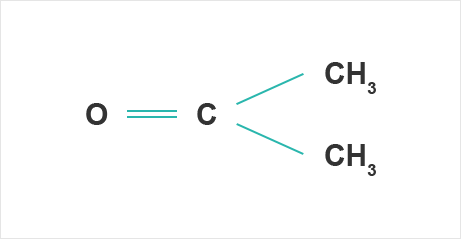
ACETONE

IUPAC name
Propanone
Synonyms
ß-ketopropane, Dimethyl ketone, DMK,
Dimethyl formaldehyde, Pyroacetic acid
Molecular formula
C3H6O
CAS number
67-64-1

Overview

Acetones are a highly inflammable and transparent liquid (with a low boiling point) with a distinct, sweet smell. These liquids easily mix with water and other organic solvents in general. KPB produces acetones using cumene. Acetones are commonly manufactured alongside phenols.

Usage

Ingredient for MIBK, BPA, methyl acrylates, pharmaceuticals and a wide range of coating agents and plastics.

Attributes

Sales Specifications

Sales Specification Table
Packing Units 160kg / 200ℓ steel Drum
ISO Tank, Bulk
Purity, wt.% 99.7 Min.
Color, Pt/Co 5 Max.
Water Content, wt.% 0.3 Max.
Sales Specification Table
Specific Gravity @20℃ 0.790 ~ 0.793
Acidity (as acetic acid), wt.% 0.002 Max.
Permanganate Time 150 Min.
Non-Volatile matter, %(g/100ml) 0.001 Max.
Water Misciblility Pass

Typical Properties

Typical Properties Table
Appearance Clear, Liquid
Molecular Weight 58.08
Odor Mild, Sweetish
Boiling Point, ℃ 56
Melting Point, ℃ -95
Flash Point, ℃ -20
Typical Properties Table
Autoignition Temperature, ℃ 465
Vapor Pressure @20℃, mmHg 180
Vapor Density *[air=1] 2
Viscosity @25℃, cP 0.303
Explosive Limits, vol.% (Lower) 2.2%
(Upper) 13.0%

As for information on handling as well as Environmental / Safety / Health information,
please click the link to the MSDS at the top of this page and see the MSDS in the Technology Database.

Contact

담당 부서 표
Nature of inquiries Department Location Telephone Email
Sales/distribution (outside Korea) Phenol Chain Overseas Sales Team Seoul +82-2-6961-3479
Sales/distribution (in Korea) Phenol Chain Domestic Sales Team Seoul +82-2-6961-3457
Technical Support Quality Management Team (Plant I) Yeosu +82-61-688-3863

(company-specific) Approved EXporter

This system has been introduced to provide support for time and cost savings at the time of issuing a certificate of origin as an increasing number of countries have signed free trade agreements.

A system where the customs authorities provide any exporter approved as capable of proving the origin of the goods with such benefits as simplified procedures for the issuance of certificates of origin, omission of the submission of attached documents, etc.

* Korea-EU FTA : In the case of the exportation of any consignment consisting of originating products whose total value exceeds 6,000 euros, only an approved exporter can self-issue a certificate of origin.
* Korea-ASEAN, China, India, Singapore, Vietnam FTA : Submission of attached documents may be omitted when applying for the issuance of a certificate of origin.
* Korea-EFTA FTA : When an exporter self-issues a certificate of origin, such exporter’s signature may be omitted.

Differences between the company-specific AEX and the product-specific AEX.

  • The company-specific approved exporter system is a blanket authorization system where the procedures for issuing a certificate of origin are operated in a simplified way for all the free trade agreements and all the export goods.
  • The product-specific approved exporter system is a system where the procedures for issuing a certificate of origin are operated in a simplified way after granting authorization as an approved exporter for each relevant FTA and the six digits of each relevant HS code.
Close layer

AEO (Authorized Economic Operator)

An authorized economic operator (AEO) is a “party involved in the international movement of goods in whatever function that has been approved by or on behalf of a national customs administration as complying with the World Customs Organization (WCO) or equivalent supply chain security standards.” Authorized Economic Operators include companies and parties concerned that are related to logistics such as importers, exporters, transporters, transportation brokers, warehouses operators, and customer brokers. The AEO concept was established by the WCO and the international community to ensure the security and smooth movement of goods in response to the U.S. trade security measures, which were reinforced after the September 11 attacks.

The introduction of the AEO program enables customs a